Orbis Environmental Consulting

YOUR DAILY DOSE OF BOTANY – JANUARY 2014


Monoecious vs. Dioecious

Scott Namestnik, snamestnik@orbisec.com

Yellow Trout Lilly
Yellow Trout Lily (Erythronium americanum), with perfect flowers
American Hazelnut
American Hazelnut (Corylus americana) has both male flowers (yellowish catkins) and female flowers (with reddish stigmas, in top left of photograph) on the same plant
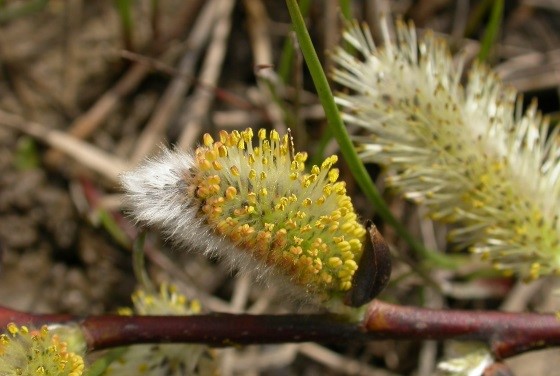
Staminate Flowers of Pussy Willow
Staminate flowers of Pussy Willow (Salix discolor)

If you’ve spent time using keys to identify plants, it is very likely that you’ve run into road blocks in the form of the words monoecious and dioecious.  What do these terms mean?
Most plants have flowers that contain both male parts (stamens) and female parts (pistils).  Think of the flowers of a Yellow Trout Lily (Erythronium americanum), for example.  When each flower has functional male and female parts, as is the case in Yellow Trout Lily, the flower is said to be perfect.  An imperfect flower, then, is one that has either functional male parts (staminate flowers), or functional female parts (pistillate or carpellate flowers), but not both.  When a plant has imperfect flowers, they can be arranged in one of two ways.  If all of the flowers on a plant are either staminate or pistillate, the plant is said to be dioecious, and the plant is then considered either a reproductively male individual or a reproductively female individual.  Willows (Salix spp.) are dioecious, because you will only find staminate or pistillate flowers on an individual plant.  On the other hand, if a plant has imperfect flowers, but

both staminate and pistillate flowers are found on the same plant, the plant is said to be monoecious.  An example of a genus of monoecious plants is hazelnut (Corylus spp.).  One way to remember the difference between monoecious and dioecious plants is to look at the translations of the words monoecious and dioecious.  Monoecious” is translated as “single house,” meaning that male and female flowers are found on a single individual.  This contrasts with the translation of dioecious, which is “double house.”  This means that male flowers are on one plant and female flowers are on another plant.

Pistillate flowers (and fruit) of Sage Willow (Salix candida)

If you have a question about plant terminology or morphology that you would like answered in a future edition of this column, send me an email at snamestnik@orbisec.com.  I may not be able to address all requests given the space allotted for this column, but I will answer those that I can.

Click here to see more of Scott’s informative work


<Back to Your Daily Dose of Botany


Tessa M. Aby-Kruger

Botanist

Tessa is a geologist, botanist and vegetation ecologist with over 10 years of experience managing and conducting projects, specializing in ecological and floristic inventories, rare plant surveys, and vegetation monitoring. She also performs wetland evaluations and is a guided hike leader.

Jeremy Sheets

Senior Wildlife Biologist, Vice President

Jeremy is a founding member of Orbis and directs its ecological and wildlife surveys, assessment and planning services, and brings over 20 years’ experience conducting various wildlife surveys with a focus on bat ecology and urban wildlife management.


Jeremy has managed wildlife projects for private firms and the public sector including for wind facilities, pipelines, roadways, military bases, and airports. Jeremy is proficient in wildlife management/control techniques, wildlife identification, threatened and endangered species, and surveying and analysis techniques for mammals, birds, reptiles, amphibians, fish, and insects. Jeremy is a Federal Aviation Administration (FAA) Qualified Airport Wildlife Biologists who develop Wildlife Hazard Assessments (WHA) and Wildlife Hazard Management Plans (WHMP) for airports. Jeremy is qualified to inspect erosion, sediment and stormwater plans, and their implementation. Furthermore, Jeremy is federally permitted to conduct endangered bat surveys in USFWS Regions 3, 4, 5, and 6 and includes acoustic surveys, mist-netting, and radio telemetry.

J Ryan Duddleson​

Senior Archaeologist, Principal

Ryan is a founding member of Orbis and directs its cultural resource management services, and brings over 20 years’ experience helping clients assess and minimize the risk of impacting places with cultural value.


Ryan works with public sector clients including federal, state, and municipal government, as well as private firms in energy, transportation, industrial, and development sectors. He also coordinates with agencies and consulting parties involved with the National Environmental Policy Act, Section 106 of the National Historic Preservation Act, and other related cultural resource laws and regulations. He performs archival research, analysis, and excavation. Ryan also has experience in artifact and archival curation. He has applied innovative techniques to traditional artifact analysis, such as examining organic residues from prehistoric pottery to determine prior contents. Ryan also has experience with human remains in archaeological settings. Ryan meets the Secretary of the Interior’s Standards and Guidelines for Archaeology and Historic Preservation, 48 FR. 44716 and is a Qualified Professional Archaeologist in Indiana, Illinois, Iowa, Michigan, Ohio, Pennsylvania, and Wisconsin.