
YOUR DAILY DOSE OF BOTANY – JANUARY 2013
Tree and Shrub Leaf Arrangement
Scott Namestnik, snamestnik@orbisec.com
Identifying deciduous trees and shrubs in winter can be a difficult task. After the leaves have fallen, what is left to help you determine what species you are observing?
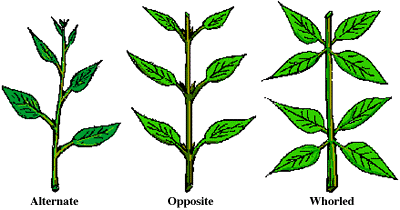
Believe it or not, there are several parts of the tree or shrub that can be used to help you identify your unknown. The buds, leaf scars, and bark are all useful to get to genus or species, but before you look at these parts, check out the leaf and branch orientation. Leaves and branching can generally be arranged in one of three ways: opposite, alternate, or whorled. I use the word “generally” because occasionally a tree or shrub can have subopposite leaves or branching, which means that the leaves or branches are slightly offset from being truly opposite.
When two leaves or branches originate from the same location on the stem, and as a result are located opposite of each other, they are considered opposite. If each leaf or branch originates from a point on the stem without another leaf or branch mirroring it, such that the leaves or branches are staggered along the stem, they are said to be alternate. If three or more leaves or branches originate from the same location on the stem, they are said to be whorled.
If you are looking at an unknown tree or shrub and can determine the arrangement of the leaves or branches, you’ve already narrowed down the possibilities. How is this possible? Just remember “a madcap bucking horse.”
The first rule in botany is that there are exceptions to nearly every rule in botany. That said, applying “a madcap bucking horse” to a leafless tree or shrub should help you identify it. Often, a tree or shrub that has opposite leaves and branches will be one of the following: a plant in the family Adoxaceae (including elderberry [Sambucus spp.] and viburnum [Viburnum spp.]), maple (Acer spp.), ash (Fraxinus spp.), dogwood (Cornus spp.), a plant in the family Caprifoliaceae (including honeysuckle [Lonicera spp.] and bush honeysuckle [Diervilla spp.]), buckeye (Aesculus spp.), or the non-native horse chestnut (Aesculus hippocastanum). Trees or shrubs in this geographical area that have whorled leaves will likely be catalpa (Catalpa spp.) if a tree or buttonbush (Cephalanthus occidentalis) if a shrub. If you have alternate leaves or branches, your task is a bit more difficult. Most of our trees and shrubs have alternate leaves and branches, but you can be assured that the tree or shrub is not one of those listed above as having opposite or whorled leaves and branches. Considering the rough guidelines above may help to narrow down the identity of the unknown tree or shrub, even in winter.
If you have a question about plants that you would like answered in a future edition of this column, send me an email at snamestnik@orbisec.com. I may not be able to address all requests given the space allotted for this column, but I will answer those that I can.