
YOUR DAILY DOSE OF BOTANY – FEBRUARY 2013
Fruit Salad Part I
Scott Namestnik, snamestnik@orbisec.com

If asked to describe a fruit, most people would immediately turn their minds to the produce isle at the grocery story. This is not the case for a botanist. As the seed bearing part of a plant consisting of a mature ovary and sometimes additional flower parts, the fruit is certainly one of the most important structures when it comes to plant reproduction and biogeography. Over time, flowering plants have evolved to form different types of fruit to account for different seed dispersal strategies. Fruit can be fleshy or dry, and there is considerable variability within each of these types. In this article, we will look at the three types of fleshy fruits.
When you think of a fleshy fruit, you may think of something like a cherry (Prunus spp.). A cherry is a good example of a drupe, which is a fleshy fruit that has a single seed per carpel (a carpel is a chamber within the ovary) and a stony endocarp (inner layer) that tightly surrounds the seed. Using the example of a cherry, the ovary has a single carpel with a single seed, and when the fruit forms, the “pit” is the stony inner layer of the fruit; the seed is inside of this stony layer.
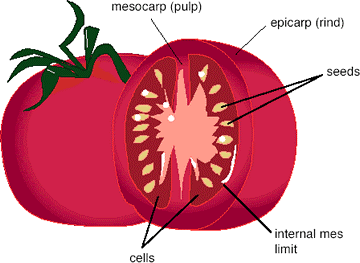
You’ve probably heard the argument that a tomato (Lycopersicon spp.) is a fruit. Well sure it is… it is the matured ovary and contains the seeds! No one would argue that a tomato is fleshy. If you cut a tomato in half, you will see that it has several carpels, but instead of having just one seed per carpel, tomatoes have many seeds per carpel. In addition, the inner layer of the fruit wall is not stony but rather is also fleshy. These are the characteristics that lead to the tomato being categorized as a berry.When you think of a fleshy fruit, you may think of something like a cherry (Prunus spp.). A cherry is a good example of a drupe, which is a fleshy fruit that has a single seed per carpel (a carpel is a chamber within the ovary) and a stony endocarp (inner layer) that tightly surrounds the seed. Using the example of a cherry, the ovary has a single carpel with a single seed, and when the fruit forms, the “pit” is the stony inner layer of the fruit; the seed is inside of this stony layer.
The third type of fleshy fruit is represented by the apple (Malus spp.). In the apple, the compound ovary and the hypanthium (the fused bases of the sepals, petals, and stamens) together form the fruit, which is known as a pome. The endocarp forms the core of the apple, within which the ovary and seeds are found. You can often see the remains of the sepals on what we consider the bottom of the apple, opposite the stem, which is on what we consider the top of the apple. Because the ovaries are located below the attachment of the floral parts, the ovaries are said to be inferior; pomes have inferior or half-inferior ovaries.

The next time you’re eating a salad or shopping for groceries, be sure to think about the types of fleshy fruits and try to determine which type(s) you have.The third type of fleshy fruit is represented by the apple (Malus spp.). In the apple, the compound ovary and the hypanthium (the fused bases of the sepals, petals, and stamens) together form the fruit, which is known as a pome. The endocarp forms the core of the apple, within which the ovary and seeds are found. You can often see the remains of the sepals on what we consider the bottom of the apple, opposite the stem, which is on what we consider the top of the apple. Because the ovaries are located below the attachment of the floral parts, the ovaries are said to be inferior; pomes have inferior or half-inferior ovaries.
If you have a question about plant terminology or morphology that you would like answered in a future edition of this column, send me an email at snamestnik@orbisec.com. I may not be able to address all requests given the space allotted for this column, but I will answer those that I can.
Click here to see more of Scott’s informative work
<Back to Your Daily Dose of Botany